A Tailored Trajectory

We are happy to share some exciting news about the future of education at Nova Pioneer. In line with the Kenya Ministry of Education’s rollout of the Competency-Based Education (CBE) in Senior School at the start of the 2026 academic year, we are thrilled to announce the launch of our

We are happy to share some exciting news about the future of education at Nova Pioneer. In line with the Kenya Ministry of Education’s rollout of the Competency-Based Education (CBE) in Senior School at the start of the 2026 academic year, we are thrilled to announce the launch of our Senior School programme under the CBE curriculum. Over the past 18 months, our teams have been hard at work to ensure that we are ready for the Senior School rollout and this development marks a major step forward in enhancing the educational journey for our students.

At our Tatu City Campus, we will be offering ALL THREE pathways: STEM (Science, Technology, Engineering, and Mathematics), Social Sciences, and Arts & Sports Science. We will offer TWO pathways at the Eldoret Campus and at the Athi River Campus, where we will be launching STEM and Social Sciences

Our offering across the Athi River, Eldoret and Tatu City campuses allows current students to transfer between campuses, allowing families to  choose from day, weekly boarding, or full boarding options; ensuring they can fully immerse themselves in their studies in an environment that best suits their needs. We continue to be committed to designing a student experience that ensures learners can pursue their interests and develop crucial skills for the future, all while being mindful of the costs associated with delivering the experience.

  1. Innovation & Leadership Programme

Students hone in on Character, reflecting deeply on their  values and beliefs. They then develop skills that will help them solve real-world problems through the frameworks of innovation, social entrepreneurship, and leadership.

  1. Beyond The Classroom Opportunities

We recognize the contribution of physical education and the arts to the health and well-being of our students and believe that a varied co-curricular and extra-curricular opportunities have a positive influence on the concentration, attitude and academic achievement of all students. Thus, we offer a wide range of musical, arts and sports activities and the opportunity for students to participate competitively both locally and internationally in their chosen club or sport.

Challenging our students outside the classroom strengthens their teamwork, resilience and leadership skills. Our Novaneers build valuable skills and attitudes that become lessons for life through their extra-curricular activities.

  1. Culture First

Our culture principles are cemented both inside and outside of the classroom, through collaboration on projects, sport and community engagement opportunities.

By exploring culture and integrating it as part of character development, our students take on daily challenges with a strong sense of purpose, service and innovation. 

  1. Post School Success Programme

We have designed a unique programme with the purpose of facilitating each student’s exploration and understanding of themselves with a focus on post-secondary opportunities available to them. Our Class of 2023 received over $7,000,000 in scholarships from universities in Australia, Canada, Germany, Ghana, Kenya, and the United States of America (U.S.A).

Are you a Grade 9 (CBE) student or a parent looking ahead to Senior School? Join a school that sees your potential and prepares you for a future without limits.

Applications for 2026 are now open

To learn more about our CBE pathways, click on this link to put in an application and get invited to our next open day or get a chance to book a personalized tour of our campuses. 
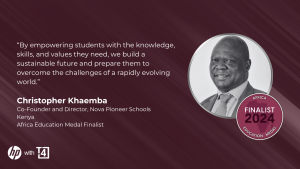
Nova Pioneer’s Christopher Khaemba named Finalist for Africa Education Medal 2024

Founded by T4 Education and HP, the Africa Education Medal is Africa’s most prestigious education accolade. Kenya’s Christopher Khaemba, Co-Founder and Director of Nova Pioneer, has been named among the ten Finalists for the Africa Education Medal 2024. Founded by T4 Education and HP, the Africa Education Medal is Africa’s

Founded by T4 Education and HP, the Africa Education Medal is Africa’s most prestigious education accolade.

Kenya’s Christopher Khaemba, Co-Founder and Director of Nova Pioneer, has been named among the ten Finalists for the Africa Education Medal 2024. Founded by T4 Education and HP, the Africa Education Medal is Africa’s most prestigious education accolade.

The Africa Education Medal recognises the tireless work of those who are transforming education across the continentcelebrating the stories of those who have lit the spark of change so others will be inspired to take up the torch. It is given to an outstanding individual who has demonstrated impact, leadership, and advocacy in the field of education.

The winner of this year’s Africa Education Medal will be invited to attend the World Schools Summit in Dubai on 23-24 November and, in recognition of the urgent need to solve the teacher recruitment and retention crisis to tackle learning gaps, the winner will be entitled to nominate a school of their choice to receive membership of T4 Education’s Best School to Work programme – an independent, evidence-based mechanism to certify schools for their culture and help them transform their working environment to attract and retain the best teachers.

Christopher Khaemba is a Kenyan educator and Co-Founder and Director of Nova Pioneer, a pan-African school group with the mission of developing innovators and leaders who will shape the African Century. He has focused his life’s work on building institutions that stand as beacons of what is possible in African education, impacting 20,000 students and 2,000 teachers.

Khaemba began his career in Kenya’s air force, before he made the decision to go into teaching Physics and Mathematics, quickly rising to school leadership at Friends School Kamusinga and The Alliance High School. It was in this role that Khaemba began his work developing generations of skilled and ethical African leaders, which he continued as Founding Head of the African Leadership Academy. His commitment to developing young Africans with leadership capacity and a desire to shape the world for the better saw him co-found Nova Pioneer.

Khaemba recognises that youth leadership development is critically important to the continent’s future, and therefore to the world. Africa is increasingly the world’s largest source of talent and human capital. However, current and traditional education across the continent – even in relatively well-resourced schools – is highly rote and falls far short of the development of holistic leadership and creative capacities that Africa and the world needs.

Through all his work, Khaemba has helped 20,000 young Africans graduate with an excellent education that has provided them with the holistic character, academic, personal competence, and social capital development they need to shape society. His former students today represent a dynamic community of leadership in all sectors of Kenyan society and across the African diaspora. Notable students include James Mwangi, Kihara Maina, James Mworia, John Gachora, Humphrey Wattanga, Martin Mbaya, Edward Ndopu, William Kamkwamba, Linda Dounia, Eddy Oketch, Fatou Fall, and Oyindamilola Adefisayo.

Khaemba’s transformative work in education attracted the attention of Kenya’s President Mwai Kibaki, who in 2005 awarded him Head of State Commendation in recognition of his contribution towards the development of education in Kenya. Kibaki’s predecessor, President Daniel Moi had in 1998 awarded Khaemba the Distinguished Service Medal for turning round a poorly performing Friends School, Kamusinga High School into a powerhouse of excellent student outcomes in three years.

Khaemba served on the World Economic Forum’s Council for Africa, whose other distinguished members included Grace Machel, Mo Ibrahim and Obiageli Katryn Ezekwesili. In 2009 the Council pushed Africa’s Agenda to the centre of the Forum during a meeting held in Dubai.

In 2017 Khaemba was contracted by Bill and Melinda Gates Foundation to conduct research on Africa’s education landscape. His work led to the Foundation’s decision to invest in the education activities on the Continent.

Khaemba is a former Education Advisor in the Office of the Prime Minister of Kenya and serves as a member of the Moi University Council in Kenya.

Nominations for the Africa Education Medal opened in February 2024 for individuals working to improve pre-kindergarten, K-12, vocational and university education who are either educators or school leaders, civil society leaders, public servants, government officials, political leaders, entrepreneurs, business leaders, or technologists.

In its third year, the Africa Education Medal is the oldest of the three World Education Medals established by T4 Education and HP.

The winner will be announced in October. They will be chosen by a Jury comprising prominent individuals based on rigorous criteria.

The Benefits of Private School Education

Every Year parents make a decision for their children to either join Public schools or a private school.Here are the  benefits of private school education. Enhanced Opportunities One key benefit of private schools is the enriched educational experience that pupils obtain.This is thanks to numerous additional initiatives offered at Private

Every Year parents make a decision for their children to either join Public schools or a private school.Here are the  benefits of private school education.

Enhanced Opportunities

One key benefit of private schools is the enriched educational experience that pupils obtain.This is thanks to numerous additional initiatives offered at Private Schools including; extra-curricular activities and a variety of  programs for gifted students.

At Nova Pioneer,in particular, our students are strongly encouraged to participate in at least one of our co-curricular activities. These Includes; Debate & Model UN, Journalism,Blogging & Photography, Drama/music club,Computer club, Entrepreneurship Club, Music Creation Club, Dance Club,Scouting, First Aid & Presidential Award club, Robotics & Maker club,Chess & Indoor games.

We also offer coaching for a variety of outdoor games including; Rugby, Basketball, Hockey, Football and Swimming.

Private schools can create their own teaching methods. At Nova Pioneer, We have a learning design team composed of subject matter experts. They are responsible for crafting all lessons around the Kenya Institute of Curriculum Development objectives.

Lessons at Nova Pioneer are delivered using the 5-E lesson plan. This is whereby students discover content for themselves about the lesson( They Get to explore their leadership potential), They are encouraged to be innovative and make connections of their findings with the real world.They then share their findings with the teacher in class who then gives clarification and finalizes the topic.

By the end of every topic, Our learners have done their research, engaged with each other and this enhances their understanding and mastery of topics.

Reduced class Sizes.

 Studies  have  shown that the smaller the class size the higher an average grade a student attains.

At nova pioneer, Our primary class size for Pre-Primary Class is 24 students per class where each class has 2 teachers, For the Upper classes, our class capacity is 32 with 2 teachers per class as well.

This has proven to be a very helpful teacher student ratio whereby each Student gets attention from the teacher depending on their strengths and or weaknesses.

Expectation of Success

The high  quality of education offered at private schools results in very good academic results. The mission of private schools attracted students with similar interests, passions and talents.

At Nova Pioneer, we have seen a steady improvement in our K.C.S.E grades. 80% of our candidates qualify to join Universities as the others join tertiary institutions.

Networking Opportunities

At Nova Pioneer, We have a Post School Success Team. The Team Organizes exchange programs for our students between Kenya and South Africa. The team also offer student job shadowing and internship opportunities in a variety of professional fields depending on each students’ interests.

Our students have earned  international scholarship opportunities to pursue their dream careers.

The Nova Pioneer community is also a source of networks.

Community Feel

Many Private schools make an effort to create a community environment. When school feels more like a community, students can feel safer, more comfortable and more passionate about learning.

At Nova Pioneer our culture principles create such a great bond between students and staff. We call ourselves Novaneers.

The strong feeling of community at Nova Pioneer nourishes the student’s social skills and encourages good behavior.

Excellent Resources

Most private schools have excellent resources and facilities to support learning. From well equipped classrooms to multiple sports facilities. 

At Nova Pioneer, We have world facilities that offer a great learning environment for our students.

Get in Touch With Us

If you’d like to enroll your child for the 2022 academic year, Then please get in touch with us. Visit our website to learn more about Nova Pioneer.

How Can Schools Help End the Stigma Around Menstrual Hygiene

Imagine a world where no girl or woman is held back because she menstruates.” This is the 2030 vision set by WASH United, a German non-profit organisation and the global coordinator of Menstrual Hygiene Day. Every year on May 28, nonprofits, government agencies, the private sector, the media, and individuals

Imagine a world where no girl or woman is held back because she menstruates.” This is the 2030 vision set by WASH United, a German non-profit organisation and the global coordinator of Menstrual Hygiene Day.

Every year on May 28, nonprofits, government agencies, the private sector, the media, and individuals come together to celebrate Menstrual Hygiene Day (MH Day) and advocate for the importance of good menstrual hygiene management (MHM). 

Over 800 million women and girls menstruate every day and yet, across the globe, ‘period poverty’ and stigma has been identified as a top reason for girls missing school. UNICEF has estimated that roughly 1 in 10 girls in Africa miss school because of their periods each year. Without access to proper education and resources, girls are often forced to stay home from school when menstruating. 

General practitioner, Dr Sihle Asiedu-Darkwah, strongly believes that schools, teachers, and parents can help lead the charge in ending the stigma around menstruation and support young girls as they go through this natural stage in their lives.

We caught up with Dr Sihle Asiedu-Darkwah to find out more about Menstrual Hygiene and also find out more about the role that she thinks schools and parents should play.


What are some of the issues girls and women face today with regards to menstrual hygiene?

Many females are not able to access appropriate sanitary products. This results in them using unsuitable substitutes or not leaving home at all during the menstrual period. This means that they miss out on school, work and other activities due to not being able to access sanitary products that can assist them to continue as usual during the menstrual period.

This further perpetuates the cycle of poverty – as more females do not finish school or sustain employment due to absenteeism.
Many females may not have knowledge or access to different types of sanitary products that can be more conducive to their lifestyle.

There may be females who are active/athletic and want to remain active during their menstrual period but cannot be due to the limitations of the sanitary products they have access to. Some women may have access to products such as tampons – but due to the misconception that tampons break your virginity – they will not use them.


What are some of the important things you believe parents, teachers and schools should teach their children about menstrual hygiene?

There is nothing dirty or shameful about menstruation. It is a natural process where the internal lining of the womb breaks down and is shed by the body. In the attempts to remove shame from menstruation, we need to openly talk about it and address any questions and misconceptions that both males and females may have about it.

I encourage parents to explain to their children that their experience may not be the same as their friends, sisters, or even their own experience. It may take some time to adjust to what is normal for them and to understand their own menstrual cycle. Children should never have to feel as though they can’t speak to their teachers or family if you have any questions or are unsure about the process. Healthcare providers are also a reliable person to discuss any questions that a young woman might have.

There are many different sanitary products that are available to try. Women should be allowed to choose one that fits their lifestyle. Women, young and old should not be afraid to explore their options.


In what ways can parents, teachers and schools end the stigma around menstruation and support girls with their menstrual hygiene?

Parents, teachers and schools need to have open discussions about menstruation in an environment that everyone feels safe to address their concerns or questions. In these discussions, my advice to both parents and teachers would be to (1) Address incorrect information related to menstruation; and (2) Discuss different sanitary products that are available including their advantages and disadvantages.

The Young Women Who Choose To Challenge

It must be emphasized that everyone’s experience with menstruation is unique – one person’s experience might not be the same as another person’s experience and importantly, these discussions should be had with both males and females to further destigmatise the shame associated with menstruation.

Schools should ensure that every toilet facility on premises can accommodate for females who are menstruating (having a sanitary disposal bin, toilet paper and the appropriate level of privacy to ensure that females feel safe). There should also be access to sanitary products within the school environment. This may be in the form of a vending machine or access to free products through a teacher/counsellor.


Beyond fighting the stigma around menstruation, what else can World Menstrual Hygiene Day
achieve for girls and women across the globe?

This day should be used to ensure that every female has access to the sanitary products of their choice. It should be used to call on governments to ensure free access to sanitary products so that no female should ever have to miss work, school or other activities due to a lack of access to these products. 

Dr Asiedu-Darkwah believes that her empathy is what differentiates her in her field of work, and this is what is required from schools, teachers and parents when approaching topics and issues around menstruation, with both male and female students.

It is through the community of schools, teachers and parents that we can begin to destigmatise menstruation in our spaces and create a conducive environment for girls and women to be free to be the best that they can be without feeling limited due to a natural process that their bodies experience.