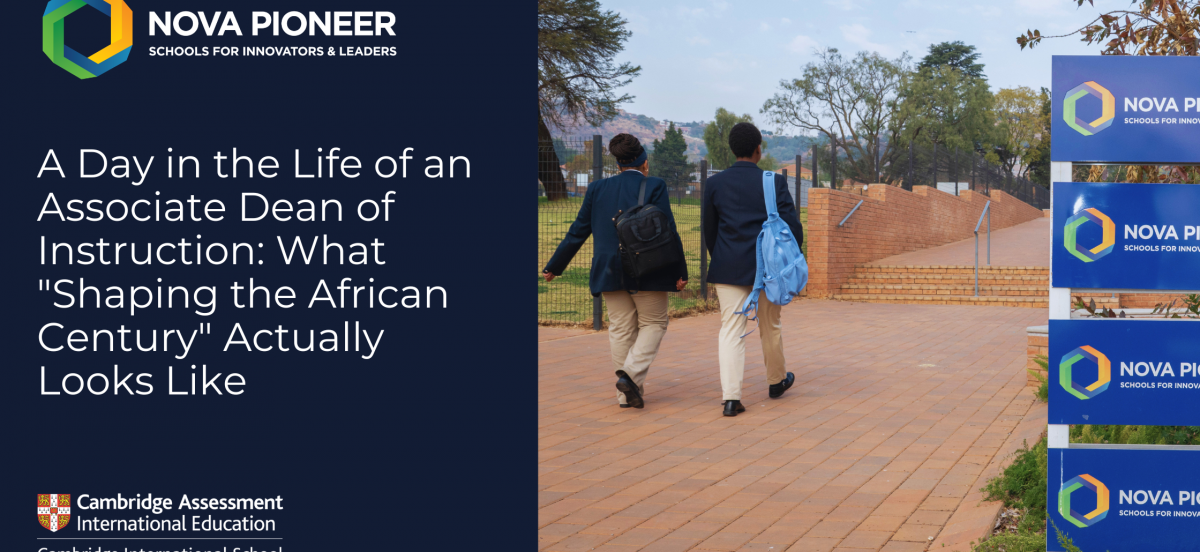
Ask anyone at Nova Pioneer why the school exists, and you’ll get some version of the same answer: to develop a generation of innovators and leaders who will shape the African Century. It’s on the website, on the walls, in every parent info session, but mission statements live in boardrooms, while missions themselves live somewhere much noisier: in corridors, classrooms, and the office of the person whose job is to hold the whole school day together. The day starts before the students arrive. Walking the campus before assembly isn’t just a security habit; it’s a chance to notice things: which classroom’s furniture got rearranged for a group project yesterday, which corridor display needs a refresh, whether the Maker’s Space looks like a place where students are expected to build, question, and take ownership, not just sit and receive. That tone carries straight into assembly, where the six culture principles stop being a poster and start being a practice. On a daily basis, a student will stand up and explain, unprompted, why a science practical failed twice before it worked, and get applause for the failing part, not just the working part. That’s the enquiry-based model in action: the goal isn’t the right answer; it’s the right question, asked persistently and in line with Cambridge standards and the thought process.
That philosophy gets stress-tested in the classroom walkthroughs. In a Nova Pioneer classroom, the teacher is rarely the loudest voice in the room, and a good walkthrough means finding a teacher mid-lesson running the I do, We do, You do method rather than simply lecturing, the actual instinct the school is trying to build into every Nova Pioneer, from preschool through to AS Level. But not every hour is inspiring.
A chunk of the Associate Dean of Instruction’s day is where the mission gets tested for real: it’s easy to talk about developing leaders in a Founder’s Day speech; it’s harder to treat a frustrated 13-year-old with the same respect and coaching you’d want for a future leader, especially on their worst day. Novaneers aren’t built in the highlight-reel moments but in how the adults around them handle the ordinary ones, which is in line with the three Cs of Character, Connections, and Capability. Nova Pioneer invests heavily here, with teachers getting well over 50 hours of professional development a year, much of it informal: a ten-minute conversation after a lesson about why a question landed flat, or workshopping how to stretch an activity for students who finished early. You can’t ask students to be curious, resilient, and reflective if the adults teaching them aren’t modeling exactly that.
Afternoons belong to chess club, robotics, debate, sports, and student council planning, where “leadership” stops being an abstraction. By the time the campus empties out, the day has usually included a hard conversation with a student who needed one, a teacher who tried something new, and a handful of “why” and “what if” questions that will probably outlast whatever answer they were chasing. That’s the honest version of “shaping the African Century”: not a single dramatic moment, but a thousand small, deliberately designed wins, repeated daily at Midrand Nova Pioneer campus, servant leadership and solutions first stop being principles on a wall and start being just how students operate.