The difference between IEB, CAPS and Cambridge

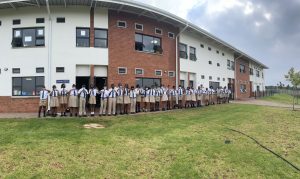
Our secondary school team has embarked on a #NextLevelCambridge roadshow, taking us to various primary schools across Gauteng.   Our mission as a team is to introduce the Cambridge curriculum to students and empower them with the information that they need to make the best decision regarding high school, particularly when

Our secondary school team has embarked on a #NextLevelCambridge roadshow, taking us to various primary schools across Gauteng.
 
Our mission as a team is to introduce the Cambridge curriculum to students and empower them with the information that they need to make the best decision regarding high school, particularly when considering Cambridge schools.
 
Cambridge can often feel intimidating for students who are not familiar with it and the roadshow provides students with an opportunity to ask questions and get insights into the curriculum.
 

A common question we get from students is “What is the difference between IEB, CAPS and Cambridge?”

 
IEB schools generally use the CAPS curriculum as a guide but grade 12 students write an alternative Matric examination that is administered by the IEB. In other words, students in CAPS and IEB schools will be taught similar content, but they will not write the same exam. Students from CAPS and IEB schools will all receive a National Senior Certificate when graduating from grade 12 – either the regular National Senior Certificate (NSC) or the Independent Examinations Board (IEB) NSC.
 
Cambridge, on the other hand, is a stand-alone international curriculum. Cambridge qualifications are not monitored by Umalusi, but by the Cambridge Assessment International Education, backed by the first-class teaching and research departments of the University of Cambridge. Students will usually complete their General Certificate of Secondary Education (IGCSE) by the time they are 16.  They then graduate from Matric with AS levels or a combination of AS and A levels (equivalent or, in some cases, surpassing CAPS grade 12 standards).
 
Want to learn more about the differences? View our secondary school presentation here.
 

Why study A-Levels?

One of the reasons that drew me to Nova Pioneer five years ago, apart from the desire to be a member of a team of educational pioneers in South Africa, was the opportunity to teach within the Cambridge system. And five years down the line, I do not regret that

One of the reasons that drew me to Nova Pioneer five years ago, apart from the desire to be a member of a team of educational pioneers in South Africa, was the opportunity to teach within the Cambridge system. And five years down the line, I do not regret that decision. What an intellectually and personally rewarding journey it has been for me, and will continue to be. The Cambridge curriculum is still quite an unfamiliar system in the South African context. Many prospective parents have heard about it, but are still not fully aware of how it works and the benefits thereof as an educational experience. At parent evenings and open days some of the most commonly asked questions are, ¨What are A levels, and why should my child consider taking them?¨ 


A Levels (Advanced Level) refers to the final two years of the Cambridge curriculum. The two-year course consists of two ´sub-phases´, AS (Advanced Subsidiary) and A2. These two sub-phases combine to equate to a full A Level. At the end of each of these sub-phases students write examinations externally set and marked by Cambridge. In the South African system, the AS Level is considered the equivalent of the South African matric, and students may apply to university locally and exit school after this point if they have achieved the minimum of four AS level subject passes (D symbol and above), including English, combined with one IGCSE pass (C symbol and above). This IGCSE pass should be in their second language. Alright, now that we have dealt with the technicalities, the question arises again. If my child can exit school at the end of their AS year (Grade 12), why should they stay on and achieve a full A level qualification at the end of Grade 13? 


There are a few reasons why we encourage parents to strongly consider full A Levels for their children. The first is that it is a well-respected international qualification and students who wish to study abroad will invariably be at an advantage in terms of university acceptance at all the world´s top tertiary institutions. Top South African universities as well have formalised their acceptance criteria for A Level candidates and these students are highly sought after locally as well. Full A Levels also provides another bite at the cherry for students who may not have achieved the university entry requirements in their AS exams. By improving their results in a 13th year, they almost always end up with a very strong university entrance qualification. 


The A Level qualification is also explicitly designed to prepare students for university study. The heavy emphasis placed on the skills of application, analysis and evaluation of knowledge means students are far better prepared for the academic rigours of university. A 2019 South African study showed that only 22% of South African students managed to complete a three year bachelor degree in the three year time period. Within the South African context there are many reasons for this. However, a key one is that generally, the South African schooling system leaves many students academically ill-prepared for the intellectual rigours of university. At Nova Pioneer part of the way we measure success is defined by our graduate’s ability to complete their university courses in the stipulated time. This is a major factor in why we chose to partner with Cambridge in providing affordable access to a curriculum specifically designed to heighten chances of success at tertiary level. The ability to inculcate critical thinking skills and an advanced level of academic literacy in our graduates will not only stand them in good stead at university, but also in the world of work after university graduation. Another important attribute developed in students within the Cambridge system is the ability to work independently. This is fundamental to success particularly in the A Level phase. Great habits learnt here carry through to university and strengthen the academic ´muscle´ needed to achieve success. The feedback I receive from former Nova Pioneer students is how much further ahead they are at university in their skills, content knowledge and academic maturity than their peers from CAPS or IEB schools. 


And finally, we tend to focus so much on the benefits of Cambridge as a pathway to academic and career success, and neglect the intrinsic benefits thereof, or the opportunity A Levels provides our students to be better, more informed human beings through study for the love of knowledge. The opportunity to focus in depth on three to four disciplines a student is passionate about is an opportunity not afforded to many students in the South African schooling system. The chance to really experience the joy of in depth intellectual fulfilment at an earlier point in their academic career is, I feel, a great privilege. This final reason is an important one, particularly for those students who have not yet decided what they want to study at university. A Levels therefore provides an opportunity for an intellectually stimulating ´gap´ year. 


The Cambridge curriculum has been designed as a thirteen year programme and so our message to prospective parents and students is that, to achieve full benefit from this rigorous and rewarding programme, the option of completing the full A Level qualification should always be one to consider when applying for study at Nova Pioneer. 


Upgrade to Nova Pioneer and give your child a head start! 

You may have some concerns about relocating your child mid-year. At Nova Pioneer, we work with our parents to ensure we provide support to students who join mid-year. Our teachers are equipped to support students in catching up on the Curriculum, and the learning model allows teachers to identify areas

You may have some concerns about relocating your child mid-year. At Nova Pioneer, we work with our parents to ensure we provide support to students who join mid-year. Our teachers are equipped to support students in catching up on the Curriculum, and the learning model allows teachers to identify areas in which additional focus is required, ensuring a smooth transition for your child. Our teachers support mid-year joiners by ensuring the following:


  • Adjusting from one curriculum to another may seem daunting, however our teachers put a lot of work into equipping students who start mid-year with the tools to thrive. Initially an assessment is done to understand the student’s baseline math and english level. Teachers then conduct weekly CFU’s (Check for Understanding) and based on these checks, the teacher is able to assess whether academic support interventions need to be taken. 
  • While ensuring that your child is able to adjust to the academic rigour of our curriculum and model, it is equally important that they receive psycho-social support with the big adjustment. Various methods are used to ensure that the student adjusts well to their environment, teachers, peers and becoming a Novaneer. 
  • Students are quickly introduced to the Nova Pioneer culture which largely assists with the social adjustment. This ranges from understanding what the 6 culture principles are, to giving snaps or shine for their own and peer achievements. 
  • Both new and existing families are supported through instructional evenings, aimed at equipping parents with knowledge to support their Novaneer’s journey in becoming a leader and innovator


Below are some tips on how parents can make the mid-year transition less disruptive.


Communicate the decision for the move

Talk with your child about moving schools well in advance, if possible. Take time to discuss each concern and allow your child to express themselves and their feelings about changing schools. This will help parents understand their child’s feelings and fears about changing schools. This can also give us insight into how we can best support them. Also ask them what they are looking forward to the most about going to a new school and talk to your child about what to expect at the new school.


Come meet our team


We always advise parents to visit the campus before the child starts classes and ensure they stay engaged with the school and teachers to find out how the child is settling in. Also, feel free to ask for more information on our psychosocial support services in case your child may need additional or professional support to adjust with the change. 


Come prepared


Make sure that your child has the correct school stationery and uniform, as well as sports clothes. Also, organise your child’s transportation to commute to and from school. Parents need to remember that children are most concerned about fitting in at school, and having the basics covered can help them integrate better into their new school environment. 


Encourage building community


Get your child involved in extracurricular activities that interest them, to help them make new friends and for them to be part of the school community. Also encourage your child to try a new activity to help them grow and expand their scope of activities at school.


Stay connected to old friends


Remember to make space for your child to reconnect and maintain communication with former school friends. It’s good for your child to not feel like they have lost or neglected their old friends, it will also comfort them to be able to keep memories of their previous school and to stay in contact with the friends that they have left behind.


Hurry, available spaces for this year are limited!


Nova Pioneer to open a new High School in 2023

Nova Pioneer announced plans to launch a new high schools in 2023. Nova Pioneer Ruimsig High Campus will be based at our North Riding campus for the first two years (thereafter moving to our Ruimsig campus in 2025) and serve Novaneers in Johannesburg West.  The new campus will cater for

Nova Pioneer announced plans to launch a new high schools in 2023. Nova Pioneer Ruimsig High Campus will be based at our North Riding campus for the first two years (thereafter moving to our Ruimsig campus in 2025) and serve Novaneers in Johannesburg West.  The new campus will cater for Grade 8 students in 2023 and subsequently add grades. Nova Pioneer is a private school network that builds and operates world-class, affordable schools, offering students grades from preschool through to high school.

Quality Education Made Accessible to More Families

Co-founder and CEO of Nova Pioneer Chinezi Chijioke said the school group’s expansion plans are guided by their mission to develop a generation of young innovators and leaders who will shape the world.

“Over the past five years, our Nova Pioneer North Riding primary school campus has only catered to students from preschool to Grade 7. However, due to the remarkable success of the campus and growing demand for a high school, we will introduce high school that will serve families in the areas as well as give Novaneers the opportunity to complete their schooling career at Nova Pioneer,” he explained.

“Nova Pioneer seeks to provide consistent excellent 21st century schooling that prepares children to thrive and lead in life beyond school, and is financially accessible – we want to reach as many families as possible. We do this through a combination of the rigorously implemented Cambridge curriculum, a teaching approach that emphasises critical thinking and student voice, and our internally developed leadership, social-emotional wellness, and post-school success programmes.”


Expansion Plans in Detail


The Ruimsig High School will initially be housed at our North Riding campus for the first two years and thereafter will move onto our Ruimsig campus ensuring it can suitably serve all students in the Randburg and Roodepoort areas. Nova Pioneer South Africa now has three high schools and we are currently enrolling for the following grades.

  • Nova Pioneer Ormonde: Grade 8 to A-Levels
  • Nova Pioneer Midrand: Grade 8 and 9
  • Nova Pioneer West (incubated at North Riding): Grade 8


Excellent Cambridge Results


Chief Academic Officer, Rahel Wondwossen said the school group offers quality education grounded in the Cambridge standards, an internationally accredited curriculum that is both locally and globally recognised. Our Nova Pioneer High schools offer grades up to, and including Grade 13, which is optional but a popular choice for many students based on their specific tertiary learning plans and, with time, Nova Pioneer West will offer all grades.

“Cambridge qualifications are internationally recognised, opening doors for Nova Pioneer students to universities in South Africa and worldwide. We are proud to be one of a few South African schools that offer the Cambridge Curriculum and are fully accredited with Cambridge International.”

Nova Pioneer students can write their IGSCE, AS-Level and A-Level examinations. Earlier this year, the school group celebrated their Ormonde High students’ Cambridge A-Level results, with a 100% pass rate and exceeded the national subject pass average. The A-Level year is ostensibly the equivalent of Grade 13 at high school level and provides students a world-recognised exit qualification to widen the scope of their university studies both locally and internationally and, depending on how they performed in their IGCSE and AS levels, gives students the opportunity to improve their options of getting into their preferred course.


Post School Success Team


Nova Pioneer places high value on students’ post-secondary school success. The school believes many elements can impact a student’s ability to succeed after completing high school. “We want to ensure that students perform well academically and ensure that they feel supported and prepared to succeed beyond Nova Pioneer. We recognise that those paths will be as diverse as our students are, reflecting their passions and talents. To that effect, we have a Post-School Success (PSS) programme to provide all students with personalised guidance on exploring post-school options. Our PSS programme is a unique offering available to our senior high students,” said Wondwossen.

Since its introduction in both South Africa and Kenya, Nova Pioneer’s PSS programme has facilitated the admission of students into renowned universities both locally and abroad. Schools for Innovators and Leaders Nova Pioneer believes too many schools focus too narrowly on knowledge memorisation and content accumulation. While Nova Pioneer considers academic mastery and skills to be critically important, it also places focus on a more holistic set of skills aligned with its vision of developing high-character leaders and innovators.

“We focus on developing our students’ character, problem-solving capabilities and interpersonal connection. We call these our ‘3Cs’. We expect our students to excel in exams and attend great universities, but ultimately our success will be measured by our graduates’ lives. By the innovations they develop, companies they launch and lead, art they create, and impact they have on their communities,” said Chijioke.

“Ultimately, we want our students to become shapers of a world they envision, rather than takers of the world they inherit. We are very proud of all our students and wish them well as they transition into the next secondary learning stage of their lives. We look forward to having our students complete their entire schooling career (Grade 000 to Grade 13) at Nova Pioneer and openly welcome students from other schools too.”

 

Novaneers admired for their strong set of values and principles

Take a few seconds to think of someone that you deeply admire…  This could be a friend, a colleague, a family member or maybe someone famous. Now note down your answers to these 6 questions, as you keep this person in mind…   Do they:  believe that they can achieve

Take a few seconds to think of someone that you deeply admire… 

This could be a friend, a colleague, a family member or maybe someone famous.

Now note down your answers to these 6 questions, as you keep this person in mind…


Do they: 

  • believe that they can achieve more by working together with others?
  • see failure as an opportunity to grow?
  • set high standards for themselves?
  • try to come up with solutions when faced with a problem?
  • put others before themselves and engage with those around then with humility and generosity?
  • remain open to learning and discovering new things?

If most of your answers were “yes” to the questions above, the person that you were thinking about and admire is undoubtedly someone who lives their life guided by a strong set of values and principles.

You may find it interesting that there were purposefully no questions above that were centred on the person’s expertise, accomplishments, capabilities, intellect or professional/career success. The person that you had in mind may exemplify all or most of the qualities portrayed in the 6 questions AND they may also be very smart, accomplished and successful in their field. (Whilst I don’t deny the value that success in one’s chosen profession or field brings, it certainly cannot be and typically isn’t, the only important ingredient!)

So my point is that many people that we admire are first and foremost deeply principled, have a growth mindset and live their lives with integrity. Isn’t this what each of us parents want for your children as they navigate their way through life… to be beacons for others around them appreciated and admired for their resilience; their selflessness; their grit and determination in the face of adversity; their curiosity and openness to grow and learn?

At Nova Pioneer, we place a lot of care and thought in integrating our school’s six culture principles into the in-class and extra-mural experiences, into how our lesson content is designed and how it is delivered. 


We have seen the power of helping students as early as pre-primary and through primary and secondary school to live by, to learn by and be guided by our SIX NOVA PIONEER CULTURE PRINCIPLES: 

  • Enquiry-based learning means that Nova Pioneer students are encouraged to ask questions; they research and explore various topics (rather than just been lectured on these) which means that they foster a sense of curiosity and exploration from a young age. They become life-long learners. Nova Pioneer current students and alumni are described as curious and wanting to learn and discover more and more about topics.  (Joy of Learning).
  • Our students are purposefully challenged; they are not scared to try new things; to fail and learn from these experiences. They also embrace feedback and see the value of giving and receiving feedback (Always Growing).
  • Novaneers work in groups on tasks, class-work and projects. They quickly experience the benefits of collaboration – a life-long skill (Greater Together).
  • It’s with great pride that we celebrate Novaneer students of all ages for their service within the school and within their community, selflessly helping others most in need (Servant Leadership).
  • Novaneer students set high goals for themselves because they are not afraid to fail and because they are not scared to try new things. They build self-confidence and set their targets high (High Expectations).
  • It is very rare that a Nova Pioneer student approaches their teacher or fellow Novaneer with a problem without a suggested solution. Novaneers are encouraged to be critical thinkers and natural problem solvers (Solutions First).

Cast your mind forward 10 or 20 years from now. Someone you know is asked to think of a person that they most admire and it is your child that comes to their mind. It is your child (probably a young adult by then) that they admire because they say that your child:

  • believes that they can achieve more by working together with others
  • sees failure as an opportunity to grow
  • sets high standards for themselves
  • comes up with solutions when faced with a problem
  • put others before themselves and engages with those around then with humility and generosity
  • remains open to learning and discovering new things.

Nova Pioneer believes that all schools should place as much focus, value and emphasis on character and value development as they do on academic excellence. Is your child’s current school doing this?


Nova Pioneer students celebrate strong Cambridge results

Nova Pioneer Schools for Innovators and Leaders, recently celebrated their Midrand students’ Cambridge Checkpoint results. Nova Pioneer students achieved scores ahead of the international benchmark for English and Science, whilst staying at pace with international trends for Maths.    Nova Pioneer is a pan-African independent school group that builds and

Nova Pioneer Schools for Innovators and Leaders, recently celebrated their Midrand students’ Cambridge Checkpoint results. Nova Pioneer students achieved scores ahead of the international benchmark for English and Science, whilst staying at pace with international trends for Maths. 


Nova Pioneer is a pan-African independent school group that builds and operates world-class, affordable schools, offering students grades from preschool through to secondary. The school group offers Cambridge, an internationally accredited curriculum, where students can write their Checkpoint, IGSCE, AS-Level, as well as their A-Level examinations in their 13th year. 


Nova Pioneer Midrand’s current Grade 7 and 8 students participated in the Cambridge Primary Checkpoint last Spring. Whilst normally administered only in the Grade 6 year, the advent of COVID in 2020 resulted in significant interruptions in the administration of these exams by Cambridge International. The disruptions as a result of COVID over the last two years have made the results achieved by these students even more impressive. 

 
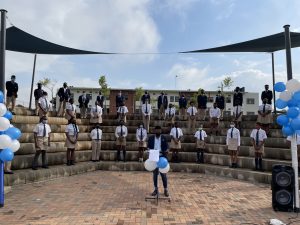
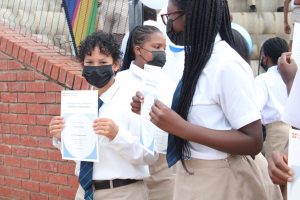
At the prize giving, Nova Pioneer acknowledged their Grade 7 top achievers for the 2021 Checkpoint, including –
  • Shalathi Shikwambana for English and Maths, as well as being the overall top achiever in the grade
  • Lwandile Mhlungu for English and Maths
  • John-David Malaba for Maths
  • Casey Oosthuzien for her top performance in Science  


In Grade 8, Nova Pioneer celebrated – 
  • Kgosi Kekane for his top performance in Maths
  • Kayden Reddy for Maths, as well as being the overall top achiever in the grade
  • Yuveer Ramalal for Maths


Xolisa Luthi, the school leader for Nova Pioneer Midrand Secondary, said that he was thrilled to have this opportunity to engage in the assessments, which provide insight into how Nova Pioneer students are progressing in their mastery of the curriculum and in their readiness for Secondary school.   


Mr Luthi expressed gratitude to the Nova Pioneer teachers and leadership team. “Our students’ impressive results reflect their tremendous diligence and tenacity, as well as the unstinting support and inspiration of their teachers. We also thank our parent community for their continued partnership”.


Nova Pioneer is currently operational in both South Africa and Kenya with the mission to develop generations of innovators and leaders who will shape the African Century. Nova Pioneer Midrand Secondary School opened its doors in January 2022 and welcomed their inaugural class of Grade 8’s. The school will expand teaching and learning to accommodate families of Grades 8 to 13 students in the Midrand area and is now enrolling for Grade 9.


Mindfulness in the Classroom

Mindfulness refers to a state of mind where a person has a heightened awareness of the internal and external experiences that are occurring at the present moment. It is a practice where your mind and all its thoughts are quietened bringing a feeling of calmness and increased awareness and focus.

Mindfulness refers to a state of mind where a person has a heightened awareness of the internal and external experiences that are occurring at the present moment. It is a practice where your mind and all its thoughts are quietened bringing a feeling of calmness and increased awareness and focus.


The concept of mindfulness is thought to have been introduced to the west by Jon Kabat-Zinn in the late 1970s, who described it as “the awareness that emerges through paying attention on purpose, at that moment.


Now more than ever, teaching mindfulness in the classroom is essential. As the world is experiencing unprecedented times with the Covid-19 pandemic.  Students, teachers, and parents feel stressed and anxious.


We also live busy lives and find our thoughts buzzing with a myriad of things to do and worry about.


As educators, we know that children learn best when they are comfortable, feel safe, and relaxed. By incorporating mindfulness in the classroom, teachers can create an environment for their students that is nurturing and non-threatening. It can set the climate for the day that is optimal for learning.


There are many benefits to mindfulness for students:


  • Reduces stress and anxiety
  • Improves attention and focus
  • Improves the student’s cognitive performance
  • Better emotional and social intelligence
  • Improves memory


There are a few ways that our  teachers incorporate mindfulness into their classrooms, 


Mindfulness Through Breathing

Teaching children to breathe deeply into their stomachs when they feel stressed and anxious. This helps to calm their body and mind.


Mindfulness Through Sensory Experiences

Sensory experiences also help children to relax and focus. By playing relaxing or classical music with calming sounds, children can focus and concentrate on the task at hand. Work produced is of a higher quality and the classroom has a calm atmosphere.


Mindfulness Through Guided Imagery

Guided Imagery can develop children’s imaginations. It helps them to integrate learning with prior knowledge. When teachers introduce a new concept, they invite children to close their eyes and slowly talk them through a journey. In this way, the children can imagine and visualize – placing them in the right frame of mind and focus. In the younger classes, children can pretend they are the animals and mimic the sounds and movements of the animals. This just helps them to relate better to the topic that will follow.


At Nova Pioneer Ruimsig, our teachers incorporate all these strategies every day in their classrooms. You will always hear relaxing background music in each class when students are working independently. Music is also used to support transitions between centres. We use Guided Imagery in the younger grades to create a fun and interactive environment before the teacher introduces the new topic. Students are encouraged to close their eyes and imagine they are various characters or in a different setting to visualize the concept. This helps students to internalize the concept using all their senses. 


Our Grade  R, 1, and 3 classes actively practice meditation each morning. Teachers have noted the benefits of meditation in their classrooms, stating that their students are calm, focused, and are able to concentrate better throughout the day. 


Deep breathing techniques are also practiced after the lunch breaks and Physical Education (PE) transitions to help settle the class for the next lesson and put them in a calm and focussed frame of mind. 


As a result of practicing mindfulness on our Ruimsig campus, our students appear calm, relaxed, and happy.


Source:

http://www.educationalneuroscience.org.uk/resources/neuromyth-or-neurofact/mindfulness-has-a-place-in-the-classroom/#

https://childmind.org

https://www.edutopia.org/blog/integrating-mindfulness-in-classroom-curriculum-giselle-shardlow


Competition time, WIN a holiday stay in Umhlanga for the family

Stand a chance to win 7 days of luxury accommodation in Umhlanga, KZN, when you tell us what makes your Novaneer child stand out.  We may be biased but we believe that Novaneers (Nova Pioneer students) stand out amongst their peers.  They’re the kind of students who aim high. They’re

Stand a chance to win 7 days of luxury accommodation in Umhlanga, KZN, when you tell us what makes your Novaneer child stand out. 

We may be biased but we believe that Novaneers (Nova Pioneer students) stand out amongst their peers. 

They’re the kind of students who aim high. They’re empowered to lead, to grow, to do more, be more and achieve great things.  #HighExpectations

Novaneers are resilient and adaptable in uncertainty. We saw this when schools closed last year and they had to pivot to a new way of learning (#AlwaysGrowing). They worked together with their peers and teachers to thrive during what may have been the toughest year for all of us. #GreaterTogether 

Our students are always pushing boundaries. They think fast to solve problems and, most importantly, they solve problems together. #SolutionsFirst

Their confidence is off the charts. They’re the kind of students who speak up because they know their voice matters! #JoyOfLearning

But most importantly, Novaneers stand out because of their big hearts – they care deeply about their peers, their learning and their teachers. #ServantLeaders

Enough about what we think however, we want to hear from you mom, dad, sister, brother or even you Novaneer, what you think makes a Novaneer stand out. How do you stand out?

Post on social media showing us what makes your Novaneer child a stand-out student, be creative and get all your friends to like and share. Tag @novapioneer_sa on Instagram and Twitter, Nova Pioneer South Africa on Facebook and @novapioneer on TikTok, using the hashtag #imaNovaneer. 

The post with the highest engagement, this includes likes, shares and comments (views excluded) will win 7 days of luxury accommodation in Umhlanga, KZN (please see terms and conditions below).

P.S: Make sure your profile is public in order for us to view and enter your video into the draw

Terms & conditions: 

  • This competition is open ONLY to current Nova Pioneer parents from schools in South Africa. Entrants would have to be a current parent at the time of the competition closing on 15 November 2021. 
  • There will be one prize of a 6-night stay at a 3 bedroom self-catering apartment in Umhlanga, KZN (sleeping a max of 6 people). This prize can only be redeemed in low or mid-season (excludes December and early January). Travel, meals, and entertainment are excluded from this prize and will be for the winner’s own account. 
  • The prize must be redeemed before 15 November 2022. Dates will be subject to availability.
  • Nova Pioneer parents and students may enter the competition utilising the following mechanism: 
    • Current Nova Pioneer parents will have to film their child (or themselves) talking about what makes their Nova Pioneer child stand out from the rest. They need to post the video online (Instagram, Twitter, Facebook or TikTok) using the hashtag #imaNovaneer and tag us on their post. The video with the most engagements (likes and shares – not views) as of 15 November 2021, will win the above-mentioned prize.
    • By entering the competition through the use of the hashtag, Nova Pioneer will consider this consent from the entrant to post on their social media platforms.
  • The winner is required to pay a R2000 breakage deposit before the stay
  • Nova Pioneer has a right (with consent from the winners to): (i) electronically publish and distribute the photos of these prize winners in any website or social media platform

(ii) include the photo(s) in advertising and promotion materials; and 

(iii) to include the photo(s) in print and non-print products.  

  • The winner will be notified by direct message via the associated social media platform.  
  • Prizes are not exchangeable, transferable or exchangeable for cash. 
  • The prize must be claimed within one month from the date of the draw.
  • All unclaimed prizes will be forfeited by 30 June 2022.  
  • Parents are to abide by the rules and regulations stated by the organizer.  
  • In case of dispute, the organizer’s decision is final and no correspondence will be entertained.  
  • This competition runs from 20 October 2021 to 15 November 2021. The winner will be announced on 20 November 2021.  
  • Nova Pioneer reserves the right to amend the terms and conditions of or withdraw this competition if required by the authorities.


Love my Mother Tongue – Love Me

Simikazi Deyi expresses the importance of mother tongue languages in an article in 2018 that states, “Language is not just a series of words, but includes certain nuances that emerge in the form of idioms, metaphors and euphemisms, as well as praises. Language is therefore tied intrinsically to a sense

Simikazi Deyi expresses the importance of mother tongue languages in an article in 2018 that states, “Language is not just a series of words, but includes certain nuances that emerge in the form of idioms, metaphors and euphemisms, as well as praises. Language is therefore tied intrinsically to a sense of belonging, which is in turn linked to society and its values”. In a country where our differences have so often divided us, our school is always looking for tangible opportunities to acknowledge the spectrum of who we are. 


Language has historically been a divisive tool in education. Used to disempower, to segregate, and to alienate children from access to quality education. One simply needs to reflect on the 1976 Soweto Uprising to realise how powerful a tool language is in creating equitable access to education. In modern day South Africa, we still struggle with classism and bias based on people’s accents when they speak in English. As schools serving children on the African continent, it is our responsibility to work to create a cohesive society, and the acknowledgement of our language diversity is one of many ways we can make this possible for our learners. 


A starting point for us was to embrace the different languages spoken by our students. In social and break settings, we do not prohibit students from speaking in their mother tongue. Rather, we seek to empower our students to understand how to include their peers, and not allow children of differing languages to feel excluded from a social group. We also encourage our students to learn language through socialising with their peers, who may speak a different language. This is a more complicated approach than simply saying everyone must speak English, however, the long term impact on social cohesion is more meaningful. 


With all this in mind, our team launched our first Love Your Mother Tongue Week (LYMT Week) in 2019. LYMT Week is a week where parents can book a slot to come in to visit their child’s class during the Morning Meeting, which is the first half hour of the day. During this time parents are invited to read a story, teach the children a song, or recite a poem in their mother tongue. During COVID parents have been able to join via Zoom. Since starting LYMT Week, we have been treated to the most rewarding recognition of who we are as a nation. Our children have experienced parents celebrating the various indigenous South African languages, Asianlanguages, English, Afrikaans, languages from the Middle East, as well languages from throughout Africa by introducing them to the rich nuances of their languages through music, poetry and storytelling. 


We host this each term in an effort to normalise the differences that make us who we are, and being mindful to not just doing this once a year on a national holiday. Operationally, this is a very simple event, which requires no changes to our timetable, and is facilitated with a simple booking form. While it is very little work to organise, the power and impact of it is huge. It is however, important that the true shift does not just come from a termly event, but rather from interrogating our policies about language, and language diversity, both formal and informal. We should continue to strive to create cohesion through our everyday actions and daily acknowledgement of our differences, or else events like this will remain hollow and will be unable to affect the change we need to see in our society.


5 Things to Consider When Looking for a High School

High school is the final phase of basic education, and the seeds planted in high school will be the fruits that will grow in tertiary. Looking for a high school for your child is no small feat. Parents want to know that their children are well prepared in high school

High school is the final phase of basic education, and the seeds planted in high school will be the fruits that will grow in tertiary. Looking for a high school for your child is no small feat. Parents want to know that their children are well prepared in high school to face tertiary education.


  1. Find out what happens to students after they matriculate


A school’s post-high school success rate is one of the first things parents ought to consider when looking for a high school for their child. At Nova Pioneer, we place great value on students’ post-high school success. We strongly believe many elements can impact a student’s ability to succeed after completing high school. Thus, we want to ensure that students perform well academically at our institutions and ensure that they feel supported and prepared to succeed beyond Nova Pioneer. 


  1. Additional support programmes


The kind of support a high school provides their students, specifically with regards to tertiary support programmes, exposure and resources – is as important as the school’s success rate. Our Post-School Success (PSS) programme at Nova Pioneer is designed to leverage different stakeholders in the student’s ecosystem, to facilitate the student’s exploration and understanding of themselves. The programme is a unique offering available to our senior high school students and it provides our students with personalised guidance on exploring post-school options.


  1. Educational philosophy 


Parents should understand the unique educational philosophy of the school that they’re considering for their child. Schools operate with different educational values and some might not be aligned with your family values or the values you wish to instil in your child. For example, public schools are typically driven by a directive to teach in order to test. On the other hand, independent schools, like Nova Pioneer, have much more creativity and flexibility to develop our curriculum to allow our students to learn in a more all-inclusive way. We, at Nova Pioneer, are intentionally developing generations of innovators and leaders who will shape the African Century.


  1. Academic programme


Parents should also get a sense of what the academic programme of the school looks like and how it fits into their child’s needs. Your child will be spending their last years of basic education at that school; make sure that the school offers classes that interest and challenge your child. Nova Pioneer offers the Cambridge Assessment International Education (CAIE) curriculum, designed to teach students how to learn and how to go on learning. Our role goes beyond helping students achieve good results, and beyond giving students passports for progression to university or employment. We give our students a curriculum that will bring lifelong success in tomorrow’s world.


  1. Classroom experience


Parents ought to have a guided experience around the high schools that they’re considering for their children. Make sure that you see the on-campus offering, facilities and how the classrooms are structured. In our classroom experience, Nova Pioneer invites parents to become students again by having them experience our unique way of teaching and experiencing what it’s like to be a Novaneer.

What parents need to remember is that there is no right or wrong way of selecting a high school for your child. Parents need to consider what will work best for their children. Place the needs of your child first when choosing a high school for them. And remember, whatever the high school has to offer your child, at the end of their high school career, the school needs to have prepared them for the next level of education post-high school.


Source